
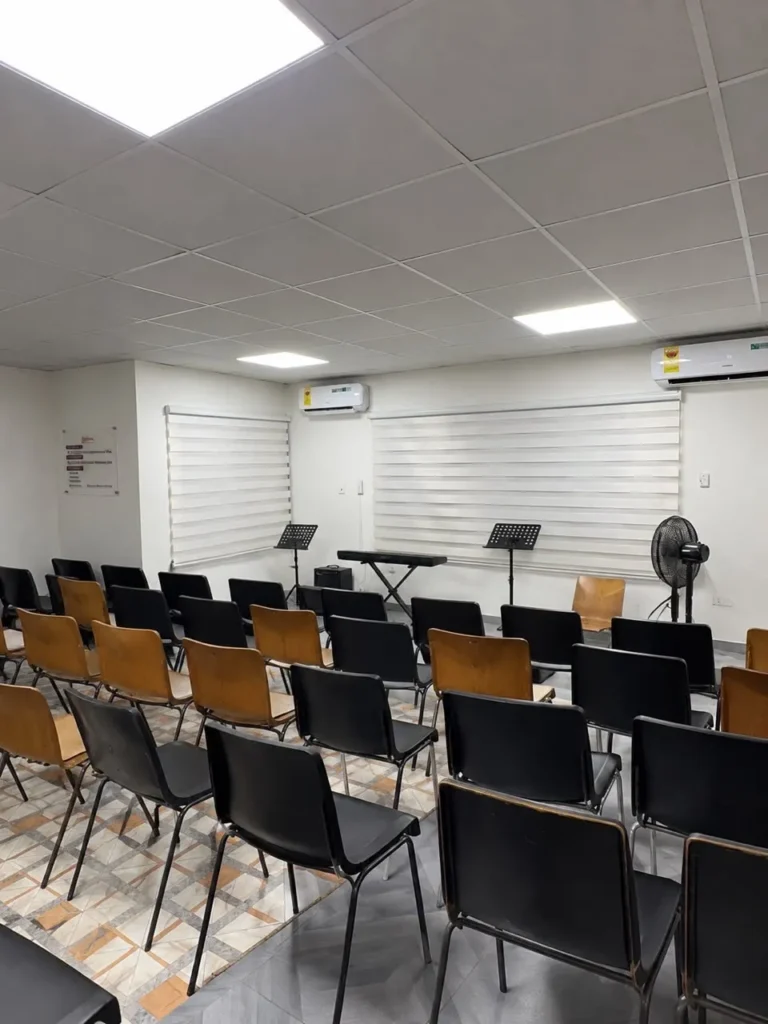
Many choir directors focus on repertoire, vocal technique, diction, and musicianship, yet one of the most influential factors in ensemble performance is often overlooked: the rehearsal venue. A room is more than a container for sound. It actively shapes what singers and directors hear, sometimes enhancing strengths and sometimes disguising weaknesses.
This is why a choir that sounds excellent in one venue may feel unbalanced or poorly tuned in another. The difference is often caused by room modes. As sound reflects between walls, ceilings, and floors, certain frequencies are reinforced while others are weakened. Instead of hearing the choir exactly as it is, singers and directors hear a version coloured by the room’s acoustics.
The most powerful resonances are axial modes, which occur between two parallel surfaces. A bass note may suddenly sound much louder because the room is reinforcing that frequency. The danger is that directors may mistake room reinforcement for strong singing, while singers may rely on acoustic support that disappears in another venue.
Tangential modes, involving four surfaces, are less obvious but can be equally misleading. They often add warmth and richness, making the choir sound smoother and more blended than it actually is. While pleasant, such acoustics can conceal tuning and balance issues that later become apparent in performance spaces.
Oblique modes, involving all six room surfaces can create confusing listening conditions. Reflections may make voices appear to come from unexpected directions, reducing clarity, affecting intonation, and making rhythmic precision more difficult.
These acoustic effects influence blend, balance, diction, and intonation. Bass frequencies are often exaggerated, while inner voices such as altos and tenors may become masked. In highly reverberant rooms, lingering sound can encourage singers to relax vocal support, causing pitch to fall. In very reflective spaces, singers may push harder for clarity, causing pitch to rise. Gradually, the choir begins tuning to the room rather than to one another.
The room also affects psychology. Reverberant spaces often make choirs feel confident and powerful because the sound blooms around them. Dry rooms may feel less rewarding, but they reveal problems more honestly and are often better environments for developing accurate musicianship.
For this reason, choir directors should evaluate rehearsal venues as carefully as musical programmes. Spaces with non-parallel walls, varied surface angles, and good sound diffusion generally provide a more accurate listening environment. Directors should move around the room while the choir sings, listen from multiple positions, and record rehearsals regularly to ensure that acoustic illusions do not influence rehearsal decisions.
Ultimately, every rehearsal involves two performers: the choir and the room. While singers create the music, the room shapes how that music is heard. Great choir directors learn to listen beyond the room’s influence so that rehearsals prepare singers for real-world performance conditions rather than acoustic illusions.
What will I recommend?
Avoid rooms where length, width, and height are equal or simple multiples of one another.
Examples of good proportions:
- 10 m × 7 m × 4 m (small choir, 20-30 singers)
- 15 m × 8 m × 6 m (medium choir, 30-60 singers)
- 20 m × 14 m × 6 m (large choir, 60-100 singers)
These dimensions help spread room resonances more evenly and reduce severe standing-wave problems.
Ideal Rehearsal Room Characteristics
- Even sound distribution across the room
- Clear perception of individual voice parts
- Accurate pitch feedback
- Good blend without masking errors
- Minimal echoes and flutter reflections
- Acoustic conditions that expose, rather than hide, performance weaknesses
In conclusion, a good rehearsal room should provide clear speech intelligibility, balanced sound across all frequencies, even sound distribution through adequate diffusion, controlled reverberation of about 0.8-1.5 seconds, minimal standing waves through limited parallel surfaces, and sufficient acoustic absorption to reduce excessive reflections without making the room sound acoustically dead.
A good rehearsal room should not make the choir sound impressive. It should make the choir sound truthful.
Disclaimer: The views and opinions expressed are solely those of the author and do not necessarily reflect the views of Prof. Music Production (PMP).